4 min read
HoverAir Versa vs. Professional DJI Aerial Filming Services
A camera that flies itself off your palm
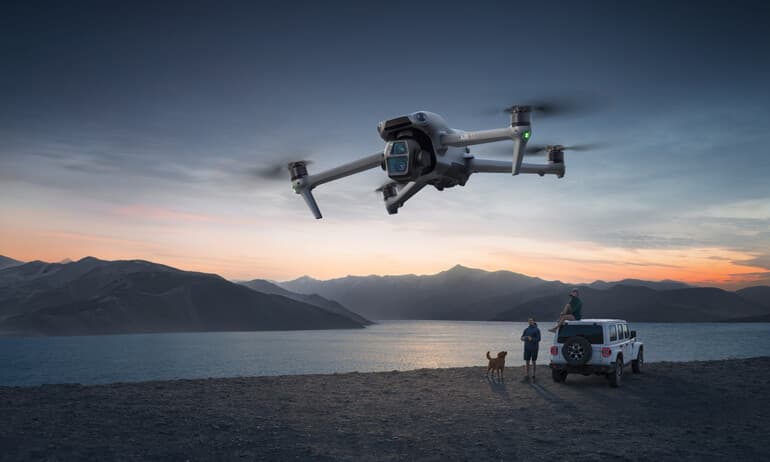
HoverAir just announced Versa, a handheld 3-axis gimbal camera that clips on a set of flight wings and takes off autonomously — no controller, no manual flying. It tracks subjects, runs preset shots like Orbit and Bird's Eye, and packs a 1/1.3-inch sensor with 4K60 and 10-bit HDR. On paper, it's the kind of device that makes anyone ask: do I still need to hire someone for aerial video?
It's a fair question, and the honest answer depends entirely on what you're shooting and who's going to watch it. A palm-launched autonomous camera is built for one person filming themselves. A real estate listing, a construction progress report, or a wedding film for a client in Sibiu or Cluj has different requirements — and different consequences if the shot doesn't land.
What a palm-sized flying camera can't do
Devices like Versa are optimized for close-range, self-tracking shots — a hiker on a Carpathian ridge, a family on a beach, a vlogger walking through a market. They struggle in wind, have limited range and flight time, and their obstacle sensing is designed to keep the device safe, not to compose a shot around architecture, terrain, or a moving subject that isn't the operator.
There's also the flight-planning side that never makes it into a product page: checking airspace restrictions near airports or protected sites, coordinating with property owners or event organizers, and adjusting a flight path on site when the wind picks up over an open field. A device that launches from your hand is built for spontaneity, not for a shoot with a deadline, a client brief, and no room for a reshoot.
Where DJI aerial filming still does the job differently
Professional DJI platforms — the Mavic and Inspire lines, paired with cinema-grade lenses and RAW or ProRes recording — cover distance, altitude, and image control that a pocket flying camera isn't built for. A property walkthrough needs consistent, level reveals across several acres. A construction site needs repeatable flight paths for progress comparisons month over month. An event needs a pilot who can adapt mid-shoot without the footage looking like a test flight.
Working across Transylvania — within roughly 150 km of Sibiu, from the Carpathian foothills to towns like Brasov, Medias, and Fagaras — also means dealing with terrain and weather that consumer autopilot software isn't tuned for. Mountain wind shear, dense tree lines, and shifting light through the day all call for a pilot making real-time decisions, not a preset shot list.
Color grading and delivery matter too. A HoverAir clip is meant to go straight from device to phone. A commercial aerial project usually needs footage that matches ground camera work, holds up on a large screen, and gets delivered in the format a client's editor actually needs.
Consumer flying cameras like Versa are worth watching — they're pushing image quality and autonomy down to a price point that didn't exist a few years ago. But for real estate listings, construction documentation, weddings, and commercial projects across Sibiu and the surrounding region, the gap between a self-flying gadget and a planned DJI aerial shoot is still wide: range, reliability, image control, and someone accountable for the outcome.
If you've got a project that needs footage you can actually use — not just footage you can film — get in touch and tell us what you're shooting. We'll tell you what gear and flight plan fits it.